
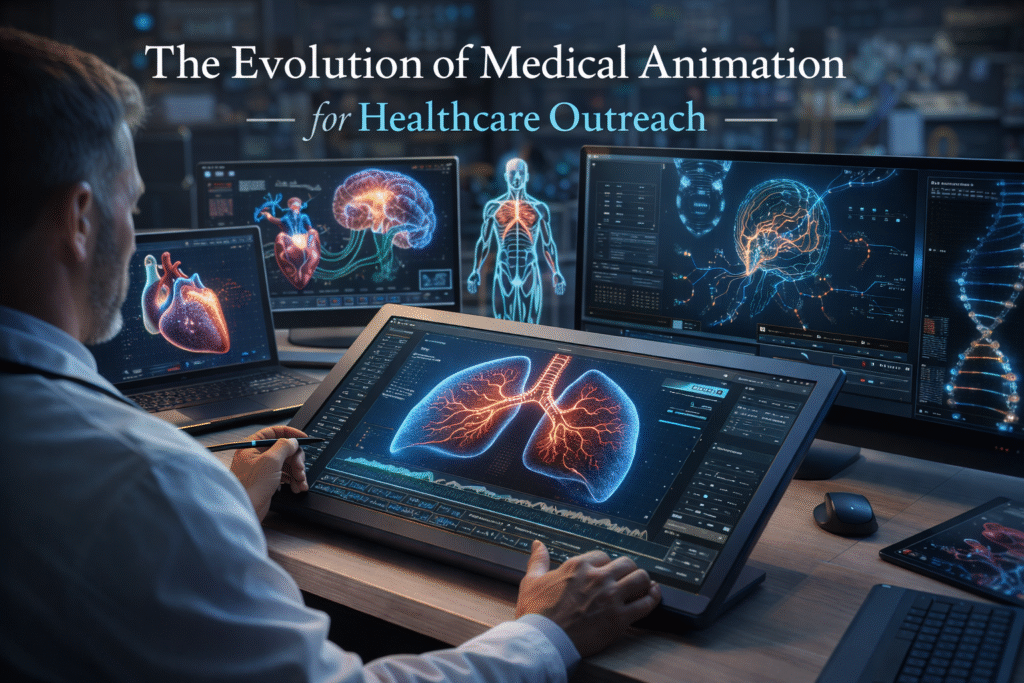
Healthcare communication has changed dramatically over the past two decades. Earlier, medical information was mostly shared through textbooks, brochures, and verbal explanations. While these methods were informative, they were often difficult for patients to understand. Complex medical terms, diagrams, and procedures made it challenging for people without a medical background to grasp important health concepts.
This challenge led to the rise of medical animation, a powerful visual tool that simplifies healthcare communication. Today, medical animation plays a crucial role in patient education, healthcare marketing, medical training, and public health outreach.
By combining science with visual storytelling, medical animation helps healthcare professionals explain diseases, treatments, and preventive care in a clear and engaging way.
What Is Medical Animation?
Medical animation is a form of 2D or 3D visual storytelling used to explain medical topics and healthcare procedures. It transforms complex medical concepts into easy-to-understand visuals.
Medical animations are commonly used for:
- Explaining diseases and conditions
- Demonstrating surgical procedures
- Educating patients about treatments
- Training medical students and professionals
- Promoting healthcare services
These animations help bridge the gap between medical experts and the general public.
Early Days of Medical Visualization
Before digital animation, medical education relied heavily on hand-drawn illustrations and physical models. These methods were helpful but limited in showing movement or biological processes.
For example:
- Blood circulation
- Cellular activity
- Organ functions
- Surgical procedures
Many of these processes are difficult to explain using static images. As technology advanced, animation provided a better way to visualize these dynamic systems.
The Rise of 3D Medical Animation
The introduction of 3D medical animation revolutionized healthcare communication. Advanced computer graphics made it possible to create realistic models of organs, cells, and biological systems.
3D medical animation allows viewers to:
- Explore the human body in detail
- Understand how diseases develop
- See how treatments work inside the body
- Visualize surgical procedures step by step
This realistic representation improves understanding for both patients and professionals.
How Medical Animation Supports Healthcare Outreach
Healthcare outreach focuses on educating communities, promoting awareness, and encouraging preventive care. Medical animation has become a powerful tool in these efforts.
1. Simplifies Complex Medical Concepts
Medical topics can be complicated. Animation breaks down these ideas into simple visuals.
For example, animation can show:
- How viruses spread
- How medications affect the body
- How organs function
- How lifestyle changes improve health
This clarity makes medical information accessible to a wider audience.
2. Improves Patient Education
Many patients struggle to understand diagnoses or treatment plans. Medical animation helps doctors explain these topics visually.
Patients can easily see:
- What is happening inside their body
- How a disease progresses
- How a procedure will help them
This improves patient confidence and trust.
3. Enhances Public Health Awareness
Medical animation is widely used in public health campaigns.
Common topics include:
- vaccination awareness
- disease prevention
- mental health education
- nutrition and lifestyle guidance
Visual storytelling helps these campaigns reach larger audiences and improve health awareness.
4. Supports Medical Training and Education
Medical schools and hospitals use animation to train healthcare professionals.
Animation can demonstrate:
- surgical techniques
- anatomy and physiology
- medical device usage
- emergency procedures
Students learn faster when complex topics are explained visually.
5. Strengthens Digital Healthcare Marketing
Hospitals and clinics use medical animation to promote services online. Videos explaining treatments or procedures help patients understand what to expect.
Benefits include:
- better engagement on websites and social media
- clearer communication of services
- stronger trust between healthcare providers and patients
This improves both education and marketing efforts.
Advantages of Medical Animation in Healthcare
Medical animation offers several benefits compared to traditional communication methods.
Key advantages include:
- clear visual explanation of complex topics
- improved patient understanding
- higher engagement and attention
- effective training for healthcare professionals
- better communication in public health campaigns
These benefits make animation an essential part of modern healthcare outreach.
The Role of Technology in Medical Animation
Advancements in technology have significantly improved the quality of medical animation.
Modern tools allow creators to produce:
- realistic 3D anatomy models
- detailed simulations of biological processes
- interactive medical learning experiences
- high-quality educational videos
These innovations help healthcare providers communicate more effectively.
Future of Medical Animation
The future of medical animation is exciting. Emerging technologies are making healthcare education even more immersive.
Future trends may include:
- interactive learning experiences
- virtual reality medical training
- personalized patient education tools
- AI-assisted medical visualization
These developments will continue to improve how medical information is shared and understood.
Key Benefits of Medical Animation for Healthcare Outreach
- simplifies complex medical information
- improves patient education
- increases public health awareness
- supports professional medical training
- enhances healthcare marketing
Medical animation helps make healthcare communication more accessible and effective.
FAQs
What is medical animation used for?
Medical animation is used to explain diseases, treatments, surgical procedures, and health concepts through visual storytelling.
Why is medical animation important for patient education?
It simplifies complex medical information, making it easier for patients to understand their condition and treatment options.
Can medical animation help in public health campaigns?
Yes. It is widely used to educate communities about disease prevention, vaccinations, and healthy lifestyles.
Is medical animation used in medical schools?
Yes. Medical institutions use animation to teach anatomy, physiology, and surgical techniques.
How does medical animation improve healthcare communication?
It turns complex scientific information into clear visual explanations that are easier for people to understand.
Final Thoughts
The evolution of medical animation has transformed healthcare communication. What once relied on static diagrams and complex explanations has now become engaging, visual storytelling that anyone can understand.
By simplifying complex medical concepts and improving patient education, medical animation continues to play a vital role in healthcare outreach. As technology advances, this powerful tool will continue helping healthcare professionals connect with patients and communities in clearer, more meaningful ways